NATIONAL FESTIVAL FOR PROMOTING TRANSPARENCY AND ELIMINATING CONFLICTS OF INTEREST.
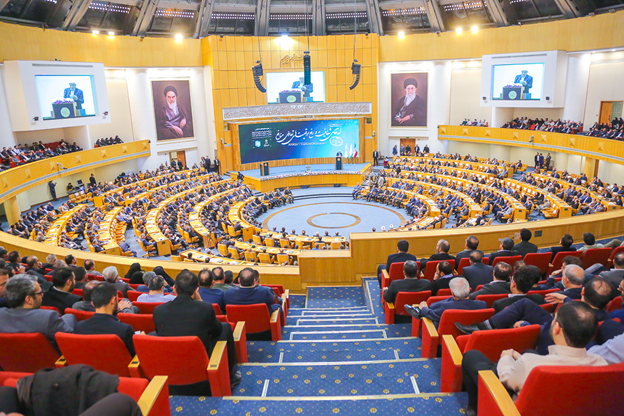
According to the Public Relations Office of the General Inspection Organization (GIO), the National Festival for Promoting Transparency and Eliminating Conflicts of Interest a nationwide event focused on transparency, accountability and reducing conditions that enable conflicts of interest was held today with senior officials in attendance. The festival’s principal aims are to strengthen public trust and to support sound governance.
The festival evaluated and ranked executive bodies in two areas — enhancing transparency and managing conflicts of interest — and honored top performers. Beyond these operational goals, the initiative emphasizes sustainable administrative integrity and the cultivation of a culture of accountability. Organized in line with the Supreme Leader’s guidance and structured around four pillars — policy, prevention, oversight and anti-corruption action — the festival is also supported by the Head of the Judiciary’s directives and the Transformation and Excellence framework.
A homegrown measurement model
A principal achievement is the development of the country’s first indigenous model for measuring transparency and managing conflicts of interest. Prepared in cooperation with academic centers including Jahad-e Daneshgahi, the model was developed through more than 30 expert sessions and roughly 3,000 hours of research. It draws on five legal categories (supreme documents, information-transparency laws, financial/economic transparency, contract/procurement transparency, and laws related to citizens’ rights) and comprises 12 macro-dimensions and 53 core indicators.
Scope, methodology and resources
In this cycle 254 entities from the three branches were assessed: 161 national and 93 provincial bodies. Approximately 570 GIO inspectors participated across a 70-day assessment period. The process involved 70 academic specialists and 560 representatives of executive agencies for data submission, verification and adjudication. Seven technical working groups met in over 500 sessions to finalize evaluations.
The evaluation reviewed 350 provisions from relevant policies, laws and regulations and used a 258-question instrument covering issues such as regulator/operator overlap, gift practices, and statutory data disclosures. The program provided about 5,920 person-hours of training for assessment officials. A dedicated platform enabled institutional self-reporting, followed by field verification and extensive joint meetings, ultimately identifying three national and three provincial top performers.
From festival to a permanent system
GIO views the festival not as a one-off event but as the first step toward a sustainable Administrative Integrity Measurement System and the annual issuance of Administrative Integrity Report Cards for agencies. Annual evaluation of transparency and conflict-of-interest management is intended to drive continuous improvement and to embed transparency and accountability in managerial culture. The festival emphasizes indicators and data over rhetoric.
Under Article 174 of the Constitution, GIO is mandated to supervise the proper conduct of affairs and the correct implementation of laws. Even where specific transparency laws are lacking, GIO considers disclosure of collective interests within its remit. Collaboration with academics and experts has strengthened the scientific basis and effectiveness of the festival’s outcomes.
Key statements and policy emphasis
Dr. Khodaeiyan, President of GIO — opening the festival, Dr. Khodaeiyan commemorated the martyrs and congratulated on the anniversary of Hazrat Fatimah Zahra (S). He defined the festival’s purpose as promoting transparency and eliminating conflicts of interest, describing transparency as clear, precise and comprehensible public access to the data and decisions of executive, judicial and other governance bodies especially for matters affecting citizens’ lives.
He explained that conflicts of interest occur when organizational interests clash with personal or factional interests, and that transparency makes such situations identifiable, thereby reducing opportunities for misuse. Over the past eight months, GIO assessed 254 bodies, reviewed 350 legal provisions, and applied a 258-question evaluation tool. The program combined training, a self-declaration platform, field verification and more than 500 joint meetings with agency representatives.
Dr. Khodaeiyan stressed prevention as the priority in anti-corruption work: “Corruption happens in darkness. Where transparency and conflict-of-interest mitigation exist, potential wrongdoers are exposed and the opportunity for misconduct is removed.” He referenced the Law on Publication and Free Access to Information, the Administrative Integrity Promotion Act, and the Transparency of the Three Branches Act, noting that agencies are required to publish officials’ names, qualifications, appointments, records, expenses, incomes, contracts and governing documents. He added that failure to upload required information is punishable under the transparency law (penalty: degree 6) and observed that the three-month legal deadline for disclosures (set in 1403) has passed; his remarks were made at the end of 1404. He closed by thanking participating institutions.
Mohammad-Reza Aref, First Vice President of the Republic praised the festival as a valuable and creative initiative that can advance administrative integrity and public trust. He highlighted inter-branch coordination and shared responsibility, warning that small unchecked corrupt practices can spread and stressing that persistent programs are needed to root out corruption. He welcomed the participation of 254 executive bodies as evidence of broad acceptance.
Ali Nikzad, Deputy Speaker of the Islamic Consultative Assembly described transparency as a practical, cost-effective anti-corruption tool. He cited parliamentary measures to publish major bank loans and debtors’ names on the Central Bank website as an example that helped resolve significant non-performing claims. Nikzad emphasized that transparency reduces the cost of prevention versus punitive action, improves policymaking by exposing decisions to expert and public scrutiny, and requires standardized, analyzable, timely and usable data rather than large unprocessed dumps. He noted that transparent contract records can enable analytical tools including AI to detect procurement patterns and offer solutions.
Hojjat-ul-Islam wal-Muslimeen Khalili, First Deputy of the Judiciary underscored the need for the three branches to act together to secure citizens’ livelihoods. He described the Transparency Law as a unifying instrument that fosters national cohesion and reduces corruption across layers of governance. Khalili urged resolute implementation of the law, framed transparency as both a public right and a managerial duty, and noted that GIO has issued 5,500 warnings to managers — a measure intended to support responsible managers. He affirmed that GIO has achieved meaningful results during four years of structural reforms and encouraged managers to use the judiciary’s supportive stance to address organized corruption and close systemic loopholes.
Awards
Top national agencies honored for transparency and administrative integrity:
- Farzaneh Ansari — Head, National Standards Organization
- Hamid Benaian — CEO, Post Bank of Iran
- Alireza Ashouri — Head, Research Institute for Industrial and Scientific Studies
Provincial awardees:
- Hamid Ghasemi — Mayor of Semnan
- Mohammad Ashouri Taziani — Governor of Hormozgan Province
- Abolqasem Mohyeddini — Mayor of Yazd
The festival was presented as the country’s first scientifically grounded national step to measure transparency and eliminate conflicts of interest across state institutions — a product of close cooperation among the three branches and executive agencies in which indicators and data, rather than slogans, form the basis of evaluation.