OLD COMPLAINTS AND INCREASING COLLECTIVE CONFLICTS WILL BE ADDRESSED, AS ACRC OPERATES THE “COLLECTIVE CONFLICT MEDIATION BUREAU” IN EARNEST.
– Dedicated personnel under the Collective Conflict Mediation Bureau will work in line with civil counselors and conflict management officials of respective institutions to actively address age-old, habituated complaints and collective conflicts as of Jan. 27
The Collective Conflict Mediation Bureau under the Anti-Corruption and Civil Rights Commission (ACRC, Acting Chairperson Han Sam Suk) officially launches on Jan 27th to specifically address old, habitual complaints that are being filed repeatedly along with the complex, fierce complaints on collective conflict which happen during the people’s daily livelihood.
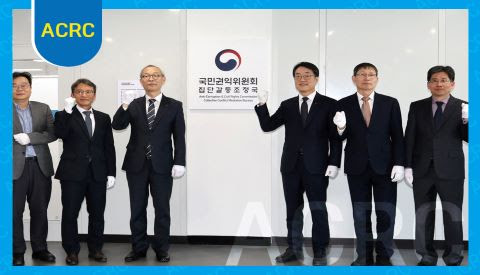
The ACRC held a board-hanging ceremony for the Collective Conflict Mediation Bureau at the KT&G Sejong Centre, along with Mr. Han Sam Suk, Acting Chairperson of the ACRC, and
Mr. Joo Jin Woo, Public Conflict Mediation Secretary of the Presidential Office, in the afternoon of Jan. 27th.
The ACRC has been focused on the practical resolution of complaints on collective conflict and repetitive, frequent habitual complaints to realize the administrative philosophy of “People-centered, Field-centered, Achievement-centered” since the launch of the new administration in June 2025 which values the sovereignty of the people.
As a result of the seven months of active resolutions – such as mediation and agreement – with the new administration, 46 collective conflict complaints were addressed and 9,375 people were directly benefited, showing an increasing trend over the same period in the previous year.
Representative cases are as follows: Mediation to come up with safety measures for tourist attractions at Guryongpo of Pohang-si in Gyeonsangbuk-do Province for the better and safer lives of the people (Jul. 2025), Mediation on bridging built-up soil area at Yanggu-si, Gangwon-do under the cooperation without silos based on mutual communication (Aug. 2025), Mediation on the safe commute of three middle and high schools students of Seongnam-si, Gyeonggi-do Province, a practical mediation for various people based on the perception that the field always has an answer (Oct. 2025), and Mediation on building a power cable for Korea Electric Power Corporation (KEPCO) at Dangjin-si, Chungcheongnam-do Province, an endeavor as an active mediator for the interests of a long-standing issue (Dec. 2025).
When it launches, the Collective Complaint Mediation Bureau will prioritize addressing age-old unusual petitions that are being filed repeatedly and continuously due to dissatisfaction or distrust of the results – and start its duty.
Its aim is not simple completion but addressing petitions so that they are not raised again, by attentively listening to and persuading the petitioners while closely cooperating with related agencies and professionals, while analyzing the causes and structures of repetition and connecting them to institutional improvement.
The Bureau will bring in 100 people including officials from the Collective Complaint Mediation Bureau, professionals in communication, counsel, and law, and civil counselors who are former public officials, and people who are in charge of the work in relevant agencies. They will be grouped considering the characteristics of the agenda items and operate as dedicated teams, for effective and systematic resolution of the petitions.
At the same time, the Commission prepared and is under discussion with the National Assembly regarding the revised bill of the Act on the Prevention of Corruption and the Establishment and Management of the Anti-Corruption and Civil Rights Commission (Article 45-2, Paragraph 5) for every institute to have “Officials on Collective Conflict Management” to be centered on difficult agenda items such as unusual petitions and petitions on collective conflict for the improvement of all institutes’ capabilities in addressing their own agenda.
The age-old collective conflict complaints which involve multiple people and various interests, which used to be handled by the divisions under the ACRC’s Ombudsman Bureau based on the content of the petitions, will now be covered by the Collective Conflict Mediation Bureau.
For the administrative service to meet the people’s expectations, the Commission will conduct in-depth inspections by the increased number of professionals, customized mediation based on the importance, difficulty, and urgency of the agenda, and work for institutional improvement by proactively figuring out potential area of collective conflicts and cooperating with the relevant agencies.
People who want collective conflict petitions to be addressed can reach out to the e-People platform and the method will be the same as usual.
The ACRC will strengthen its solid cooperation system with the Office of the Public Conflict Mediation Secretary of the Presidential Office, as well as central administration, local government, and public institutions. The Commission will systematically respond to the pending major collective conflict items as one of the agencies in charge of governmental meetings on public conflict mediation.
It will proactively find and mediate potential areas of collective conflicts during the execution of the national agenda such as the energy expressway and balanced regional development. Complaints that are closely connected to the lives of the people and repeated complaints will be prioritized and investigated to come up with the solutions regardless of their scale.
The Acting Chairperson Han of the ACRC stated that “People want the government to listen to the voice of the field, address the long-standing collective conflict complaints, and actively engage in and mediate the stakeholders. The Collective Conflict Mediation Bureau which launches today will listen to the voices of the people and do our best to make improvements based on field experience and capabilities so that people can feel the difference.”
The Public Conflict Mediation Secretary of the Presidential Office said the “The Collective Conflict Mediation Bureau will be the key organization which comprehensively mediates habitual, repetitive conflicts and collective complaints which involve various stakeholders. I expect the organization to be at the center and listen to the people’s voices from the closest position, resolve the repeated conflicts, and conduct the necessary mediation in a timely manner. My Office will work closely with the ACRC, prevent repeated complaints from being raised again, and build a system which proactively manages and mediates collective conflicts to reduce social costs and enhance public trust.”