ACRC ANNOUNCES ITS 2025 ACHIEVEMENTS IN COMMEMORATION OF INTERNATIONAL ANTI-CORRUPTION DAY (DEC. 9).
– Marking the International Anti-Corruption Day on Dec. 9, ACRC announced key anti-corruption policy achievements … Strengthening integrity education for future generations, solidifying the Conflict of Interest Prevention Act, hosting the APEC anti-corruption meeting, etc.
The Anti-Corruption and Civil Rights Commission (ACRC, Chairperson Ryu Chul Whan) announced its 2025 anti-corruption performance on December 9 to mark International Anti-Corruption Day.
* December 9 is designated as International Anti-Corruption Day, commemorating the UN’s 2003 signing ceremony for the UN Convention against Corruption in Mérida, Mexico.
In February 2025, Transparency International (TI) published the 2024 Corruption Perceptions Index (CPI) in which Korea scored 64 out of 100, ranking 30th out of 180 countries-its highest score and rank to date.
Beyond being merely a score or ranking, CPI is a key indicator affecting national competitiveness and economic growth, requiring whole-of-government management and improvement efforts.
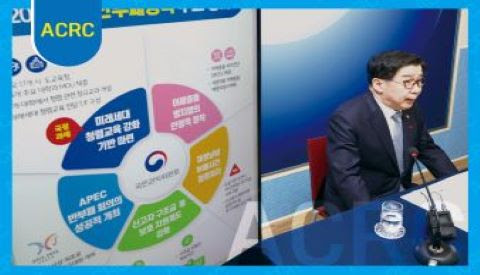
Accordingly, as the lead anti-corruption agency, the ACRC has since early this year focused on five key policies to improve CPI: building a foundation to strengthen integrity education for future generations; ensuring the stable implementation of the Conflict of Interest Prevention Act for Public Officials; strict handling of corruption cases involving fiscal waste; strengthening whistleblower protection and support systems, including expanded relief payments; and the successful hosting of the APEC anti-corruption meeting.
① Laying the Groundwork to Strengthen Integrity Education for Future Generations
The ACRC focused its efforts this year on strengthening integrity education for future generations. In August, it established a dedicated task force within the Anti-Corruption Training Institute and has been faithfully implementing the “mandatory integrity education for future generations,” a task adopted as a national agenda under the Lee administration.
The ACRC concluded MOUs on integrity education with all 17 metropolitan and provincial offices of education nationwide, as well as with 25 universities.
Based on this cooperation system, the ACRC operated “Visiting Classes for Integrity Experience” at 60 elementary, middle, and high schools, and distributed integrity education content tailored to elementary students through the education offices, enabling about 38,000 students at 142 elementary schools nationwide to learn about integrity.
In addition, integrity special lectures were offered at 20 universities this year, and at four, including Hanyang University, Jeonbuk National University, UNIST, and the Korea National University of Education, integrity courses were opened as credit-bearing regular classes.
② Stable Implementation of the Conflict of Interest Prevention Act
The ACRC worked to ensure that the Conflict of Interest Prevention Act, implemented in 2022, takes firm root in the public sector. The Act was enacted to prohibit public officials from pursuing private interests related to their official duties, thereby preventing conflicts of interest that may arise during duty performance and ensuring fair execution of duties.
To support public officials’ understanding and adaptation in the Act’s third year of enforcement, the ACRC: introduced a QR code-based self-diagnosis service to easily check for conflicts of interest; produced and distributed a guideline for preventing conflicts of interest in local councils and quarterly “Get it Right” card news; and held regional briefings for 798 agencies and 1,169 public officials.
③ Strict Handling of Corruption Cases Involving Fiscal Waste
The ACRC identified and remedied structural corruption causing significant losses to national finances through systematic fact-finding.
First, it received reports and uncovered public institutions that, in violation of government guidelines, over-allocated about 600 billion won in personnel expenses over the past eight years, and requested audits by supervisory agencies.
It also found improper execution of about 2.5 billion won, such as purchasing expensive personal items as “training expenses” and notified supervisory bodies to recover the funds, while demanding institutional improvements including sanction provisions for improper spending.
In July, a full review of seed release projects in the southwestern seas uncovered bid-rigging worth 10.3 billion won and delivery fraud worth 6.8 billion won-a total of 17.1 billion won-which was referred to the Korea Coast Guard.
Separately, to scrutinize entrenched corrupt practices in education, all 17 metropolitan/provincial education offices were inspected, revealing improper cases totaling 300 million won, including overpayments of overseas travel per diem, execution of ancillary facility costs, and operation of resort facilities.
④ Strengthening Whistleblower Protection & Support, Including Expansion of Relief Payments
Whistleblower protection and support systems, including relief payments, were significantly reinforced. Relief payments are monetary support provided to public-interest whistleblowers and their relatives/household members to compensate for damages or costs incurred due to reporting.
This year, the ACRC doubled the outpatient treatment cost limit covered by relief-from 1 million won to 2 million won-and shortened the average processing time for relief applications by 33.6% year-on-year to ensure timely support for whistleblowers.
To ly and effectively resolve situations where whistleblowers face disadvantages from their organizations due to reporting, the ACRC actively used the settlement recommendation system. While only five recommendations were made over the past five years, six were issued in 2025 alone, helping parties amicably and ultimately resolve conflicts.
To further bolster the foundation of whistleblower protection and support, the Act on the Protection of Public Interest Whistleblowers was revised to introduce a system for temporarily suspending procedures for disadvantageous measures.
For the Act on the Prevention of Corruption and the Establishment and Management of the ACRC, draft amendments were prepared and preannounced to: prohibit claims for damages against whistleblowers; and add attempts to identify whistleblowers, obstruct reporting, or coerce withdrawal of reports as grounds for presuming disadvantageous measures.
⑤ Successful Hosting of APEC Anti-Corruption Meetings
In February and July, the ACRC held the 40th and 41st APEC Anti-Corruption and Transparency Working Group plenaries to discuss the need to strengthen anti-corruption policies in the Asia-Pacific and practical cooperation measures.
From July 31 to August 1, ACRC hosted APEC’s first-ever High-Level Anti-Corruption Dialogue in Songdo, Incheon.
Ministers and vice ministers from 20 member economies, along with experts from international organizations and the private sector, attended. They focused on international cooperation to counter corruption crimes for prevention and eradication, strengthening public-private partnerships, and cooperation in international anti-corruption education, while sharing Korea’s anti-corruption policies such as the Clean Portal system, Comprehensive Integrity Assessment of Public Institutions, and multinational anti-corruption capacity-building training.
By sharing the outcomes of the APEC anti-corruption meetings with the international community-at the G20 Anti-Corruption meeting in South Africa in October and the Conference of the Parties of the International Anti-Corruption Academy (IACA) in Vienna, Austria, in November-Korea solidified its status as a global leader in integrity.
ACRC Chairperson Ryu Chul Whan said, “Through the 2025 five key anti-corruption policies, the ACRC has worked to spread a culture of integrity not only in the public sector but across society as a whole.”
He added, “I thank everyone who has worked to build a clean and fair society this year, and next year we will do our utmost to continuously improve the level of national integrity, strengthen national competitiveness, and deliver results the public can truly feel.”